Bhutan is a country of valleys. Each is cut off from the next by a ridge and a pass, and each has its own dzong, its own festival and, often, its own language. A trip is a matter of deciding how many of them you have time for.
They lie along one road, so the order is fixed: the further east you want to go, the longer you need.
| Valley | Height | Known for | Shortest tour that reaches it |
|---|---|---|---|
| Paro | About 2,250 m | The Tiger's Nest | 4 days |
| Thimphu | 2,334 m | The capital | 4 days |
| Punakha | 1,242 m | Punakha Dzong | 5 days |
| Phobjikha | About 3,000 m | Black-necked cranes | 7 days |
| Haa | Beyond a 3,988 m pass | Quiet, and Chele La | 8 days |
| Trongsa | The largest dzong | 10 days | |
| Bumthang | About 2,600 m | The oldest temples | 10 days |
| Eastern Bhutan | 1,160 to 1,750 m | Weaving, and no crowds | 14 days |
Paro
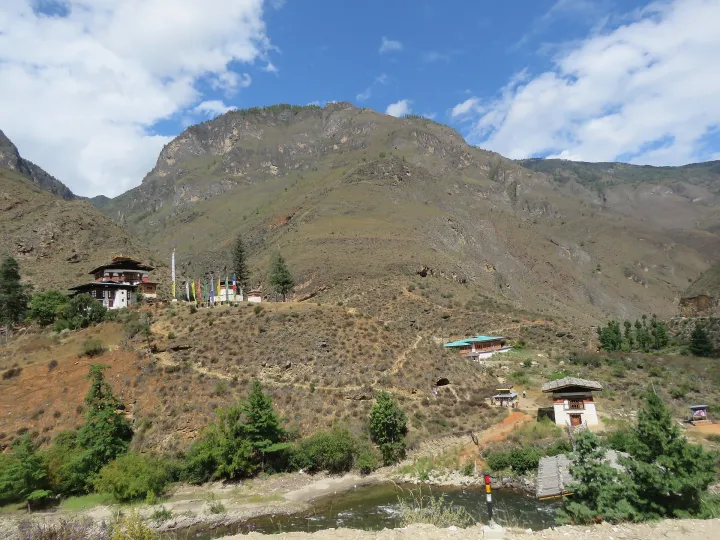
Everyone begins here, because the airport is here. Paro has the walk to Taktsang, the Tiger's Nest; Rinpung Dzong, built in the 1640s above the river; the National Museum in the watchtower behind it; and Kyichu Lhakhang, a temple of the seventh century. Give it two nights at least, and keep the Tiger's Nest for the end of your trip.
Thimphu
The capital, an hour from Paro, and the one place in Bhutan that feels like a town. See Tashichho Dzong, the seat of government, which opens to visitors at five in the afternoon; the Buddha Dordenma, a seated bronze figure 51.5 m high; the Memorial Chorten; and the school where the thirteen traditional crafts are taught. One night is enough for the sights. Two lets you add a walk to a monastery in the hills.
Punakha
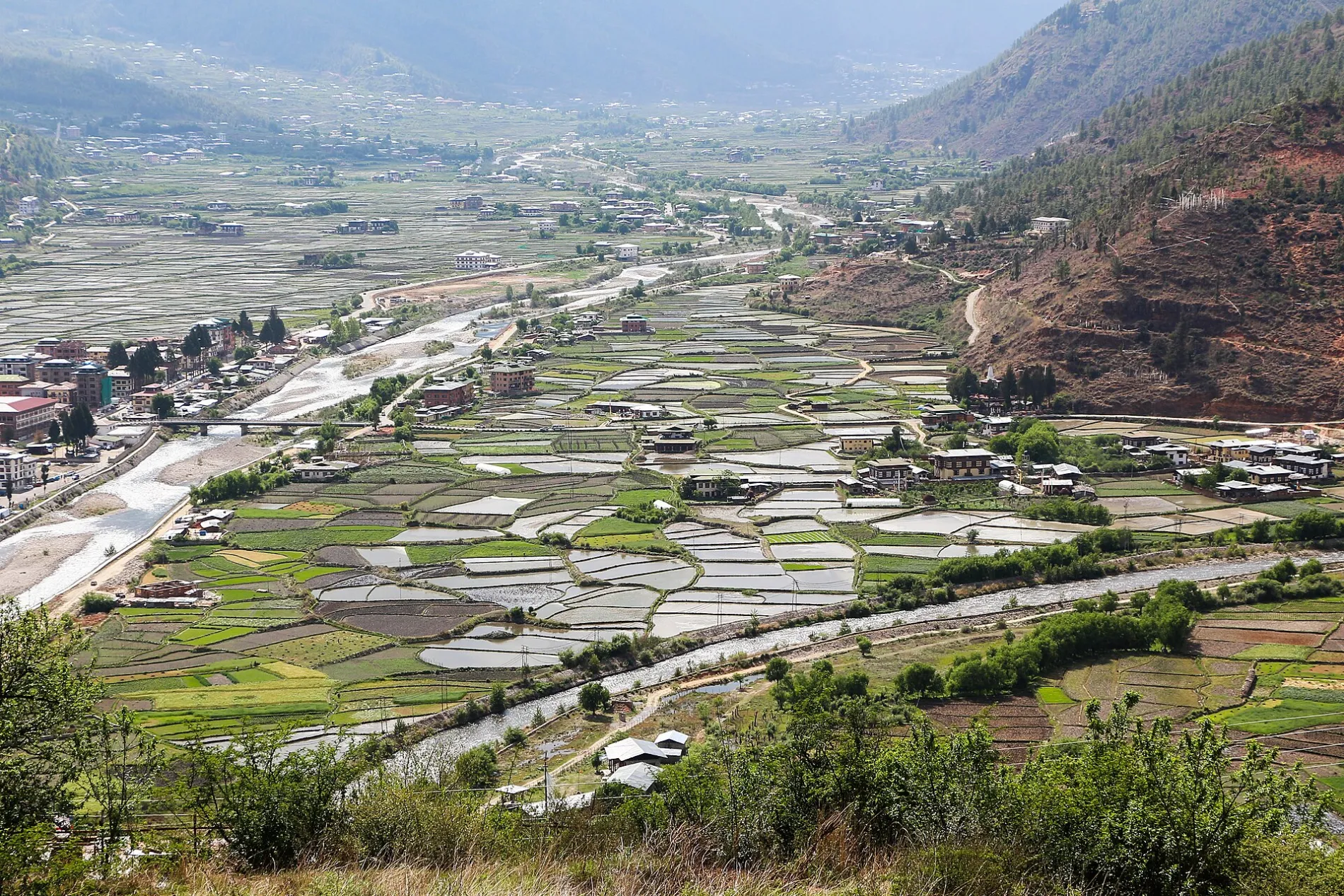
Over Dochu La and more than 1,000 m lower, Punakha is warm when the rest of the country is cold. Its dzong, built in 1637 where two rivers meet, is the one most visitors remember. There is a walk through rice terraces to Khamsum Yulley Namgyal Chorten, a suspension bridge about 160 m long, and rafting on both rivers.
Phobjikha
A wide, high valley of marsh and pasture, with the monastery of Gangtey on a hill at its head. Black-necked cranes winter here from about November to March, and are welcomed with a festival on 11 November. At other times of year you come for the walking and the silence.
Haa
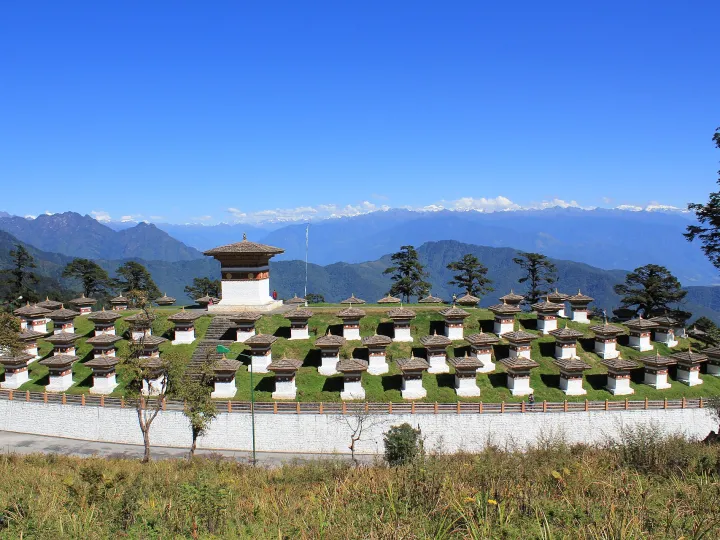
West of Paro, across Chele La at 3,988 m. Haa has two old temples, the White and the Black, and a fraction of the visitors of its neighbours. It can be seen in a day from Paro; a night there is better.
Trongsa
The centre of the country, and of its history. Trongsa Dzong, begun in 1644, is the largest in Bhutan, strung along a ridge above a gorge. The watchtower above it is now a museum.
Bumthang
Four valleys that hold many of Bhutan's oldest temples: Jambay Lhakhang, of the seventh century, Kurjey and Tamshing, with Jakar Dzong above them. Bumthang has its own festivals, among them the Jambay Lhakhang Drup in late autumn. Give it two nights, or three.
Eastern Bhutan
Beyond Thrumshing La the road drops to Mongar and Trashigang, in country that is warmer, steeper and far less visited. Come for the weaving villages, the temple of Gom Kora and the great stupa of Chorten Kora, and for the journey itself. It needs two weeks, and a liking for long days on the road.
How to choose
- Short of time: Paro, Thimphu and Punakha, in five days.
- A first visit, done properly: add Phobjikha, in seven.
- Temples and history: go on to Trongsa and Bumthang, in ten.
- Somewhere few visitors go: Haa, or the east.
All eight are described in more detail under destinations.